
Running a restaurant, café, or pub in the UK today means juggling more than good food and friendly service. Behind every till transaction sits a web of tax obligations, food safety law, and payment security standards that didn’t exist a decade ago. A modern point-of-sale (POS) often called an EPOS, or Electronic Point of Sale, in UK trade circles has become the operational backbone that ties all of this together. This guide walks through what UK hospitality operators need to know when choosing and running a POS system in 2026.
What a Restaurant POS System Actually Does
At its simplest, a POS processes orders and takes payment. But in a modern hospitality setting, it typically also handles kitchen display routing, table and floor management, stock and ingredient tracking, staff clock-in and scheduling, loyalty programmes, and reporting for accountants. The best systems act as a single hub that connects the front-of-house, the kitchen, delivery platforms, and your accounting software, rather than leaving each of those as a separate disconnected tool.
For a busy service, this connectivity matters practically as well as administratively. An order taken on a handheld device at the table should land on the kitchen display instantly, with no re-keying and no risk of a misheard modifier. When a Deliveroo, Uber Eats, or Just Eat order comes in, it should route straight to the kitchen too, rather than requiring a staff member to manually copy it across from a tablet, a common source of delay and error in venues still juggling separate delivery tablets.
UK Tax Compliance: Making Tax Digital and VAT
Tax compliance is where UK POS requirements diverge most sharply from generic international software. Making Tax Digital (MTD) for VAT has required VAT-registered businesses to keep digital records and file VAT returns through compatible software since 2019. From April 2026, MTD is extending further: sole traders with gross income above £50,000 must also file quarterly digital updates to HMRC for Income Tax, not just VAT.
A properly configured POS should calculate VAT automatically across standard, reduced, and zero rates, break it down clearly on receipts, and export clean digital records that either integrate directly with HMRC or feed into accounting platforms like Xero, Sage, or QuickBooks. For operators still relying on end-of-day paper Z-reports and manual re-entry into spreadsheets, this is one of the clearest signs it’s time to upgrade beyond the compliance risk, it doubles up the bookkeeping work and multiplies the chance of errors creeping into your VAT return.
Food Safety and Menu Regulation
UK-specific regulation extends well beyond tax. Natasha’s Law requires restaurants to provide clear allergen information across all 14 major allergens recognised in UK food law, and a well-built POS can track allergens at the ingredient level, flagging them automatically to both kitchen staff and customer-facing displays or printed materials. This reduces reliance on staff memory during a rushed service, which is exactly when allergen mistakes are most likely to happen.
Larger operators also need to account for calorie labelling rules, which require chains with 250 or more employees to display calorie counts on menus. A POS with menu engineering tools can calculate and update these automatically as recipes change, rather than leaving it to manual spreadsheet updates that quickly go stale.
Payment Security and PCI Compliance
Any UK venue accepting card payments needs to meet Payment Card Industry Data Security Standard (PCI DSS) requirements, and the current version, PCI DSS 4.0, is now contractually binding for merchants and payment processors. In practice, this means your POS and card reader setup need to handle cardholder data securely, and higher-volume venues may face more rigorous assessment requirements as their transaction volumes push them into higher PCI compliance tiers. It’s worth treating this as an ongoing conversation with your payment acquirer rather than a one-off box to tick, since requirements and thresholds can shift as your business grows.
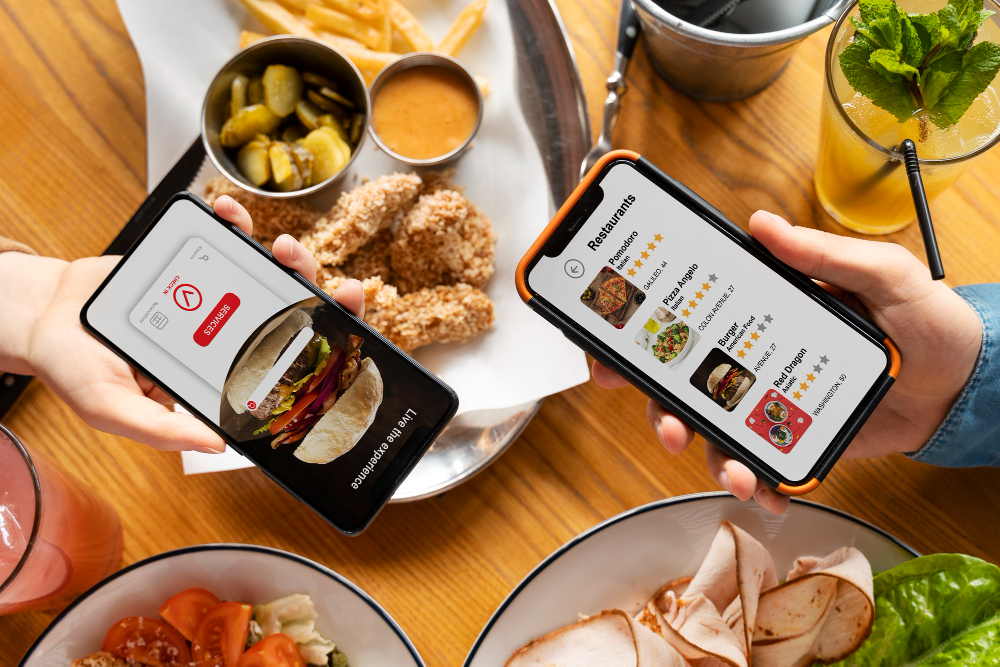
On the customer-facing side, guests now expect a full range of payment options as standard: chip and PIN, contactless, Apple Pay, Google Pay, and increasingly QR-based order-and-pay flows. A POS that treats these as native, integrated features rather than bolting on a third-party card reader as an afterthought tends to offer a smoother experience for both staff and guests, and fewer points of failure at the till.
Staffing, GDPR, and Employment Law
A POS system also touches UK employment compliance more than operators often expect. Working Time Regulations require tracking of maximum hours, rest breaks, and holiday accrual, and many modern systems now build staff scheduling and clock-in features (via PIN or biometric login) directly into the POS, with exportable data for payroll and auto-enrolment pension calculations. Any system storing customer data for loyalty programmes or marketing also needs to handle it in a GDPR-compliant way, with clear consent and secure storage.
Cloud vs On-Premise, and Choosing a Provider
The UK EPOS market has consolidated around a handful of established players Square, Zettle by PayPal, Epos Now, Lightspeed Restaurant, and SumUp among them alongside a growing number of specialist and bespoke providers targeting independent restaurants specifically. Most modern systems run on the cloud, meaning data syncs in real time across devices and locations, updates happen automatically, and reporting is accessible remotely. Cloud systems also tend to adapt faster to regulatory change, since compliance updates roll out centrally rather than requiring a manual software update at each site.
When comparing providers, UK operators should weigh: monthly cost versus per-transaction fees, hardware requirements and whether you’re locked into proprietary devices, kitchen display system (KDS) support, delivery platform integrations, VAT and MTD readiness, contract flexibility, and how well the system integrates with your existing accounting software. For very high-volume or multi-site operations, some operators find that a bespoke or custom-built POS pays for itself over a three-to-five-year period, even with a higher upfront cost, by avoiding the accumulated subscription fees and workaround costs of an off-the-shelf system that doesn’t quite fit.

Getting the Decision Right
There’s no single “best” POS system for UK hospitality; it depends on your venue type, transaction volume, staff turnover, and how many delivery and payment channels you’re juggling. But one thing has changed for everyone: Making Tax Digital, allergen law, PCI standards, and GDPR aren’t nice-to-haves anymore; they’re table stakes. Increasingly, operators are also looking beyond compliance to platforms built specifically for hospitality rather than adapted from generic retail systems. Providers like Grafterr, for example, combine POS, QR ordering, kitchen displays, and staff management into one connected system rather than stitching together separate tools, a sign of where the market is heading: fewer point solutions, more unified platforms. Whichever route you take, in 2026 picking a POS isn’t just an operational call, it’s a compliance call. Get it right the first time, and it’ll save you far more headaches than switching systems later ever will.